
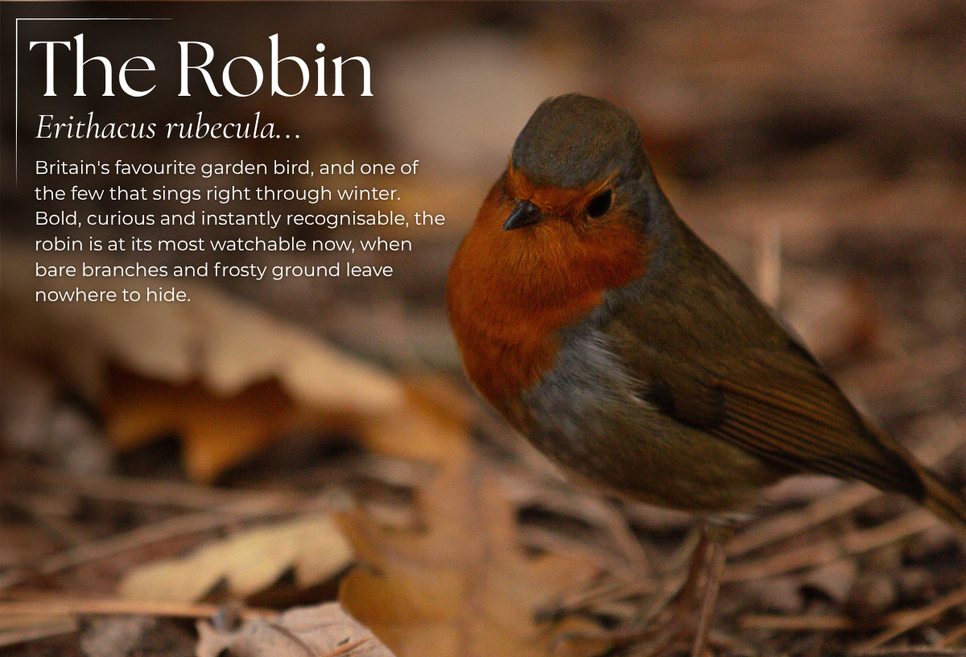
Ask almost anyone to name a British garden bird and the robin is the first to come to mind. Bold, curious and instantly recognisable, it is the bird that hops onto the spade handle the moment you start digging. But the robin is far more than a Christmas-card regular. In the colder months it becomes one of the most watchable birds in the country, and with a good pair of binoculars you can see how much character is packed into something so small.
See our robin post on Facebook →
Why November Is a Great Month for Robins
Robins are one of the few garden birds that sing right through autumn and winter. While most species fall quiet once the breeding season ends, robins stay vocal because they defend territories all year round. Both males and females sing in winter, which is why you hear that thin, silvery, almost wistful song on a grey November morning, and sometimes at dusk as the light fades.
As the leaves come down, the birds become far easier to see. Bare branches, low sun and frosty ground leave robins exposed, and they tend to stay close to people, following anyone who turns over soil in search of insects and worms. It makes November and December among the best months to watch them at close range.
Know Your Robin
The European robin (Erithacus rubecula) is a small, round, upright bird with a lot of attitude. Look for the orange-red face and breast, bordered by a soft grey edging, set against olive-brown upperparts and a pale, creamy belly. It has a large, dark, bright eye that gives it an alert, almost inquisitive look, and slim legs that it uses to hop and pause, hop and pause, across the ground.
Young robins look quite different. A juvenile is speckled brown and buff all over, with no red breast at all, and it can be mistaken for a different species until the red feathers arrive after its first moult. If you see a speckled little bird sticking close to a mature robin in late summer, that is probably a youngster.
Robins are fiercely territorial. When one spots a rival it will puff out its breast, stretch up tall and sing loudly to see it off, and disputes can turn surprisingly physical. A bright red patch is a clear warning sign to another robin.

Where to Watch Robins
Your Own Garden
The garden is the easiest place to watch a robin, and often the best. Keep a feeding spot in view of a window and offer mealworms, suet or fat-based food, sunflower hearts or chopped fruit. Robins will visit a feeder, but they often prefer to feed from a low table or the ground. Once a robin trusts a location, it will return again and again, usually at the same times of day.
Woodland Edges and Hedgerows
Away from gardens, robins are common wherever there is a mix of cover and open ground. Walk the edge of a wood or a field boundary, stop, and listen. A robin will often announce itself with a short, sharp, ticking call before you see it, perched on a low branch watching the ground below.
Parks and Churchyards
Mature parks, cemeteries and churchyards have the shrubs, old trees and open grass that robins like, and the birds tend to be bold around walkers. They are good places to practise your fieldcraft: move slowly, stop often and let the bird decide how close it wants to be.

Choosing the Right Binoculars
You do not need strong magnification to enjoy robins, because they will often come very close. What matters more is a bright, sharp, colour-true image and a view you can hold steady in cold hands. A clear picture lets you see the feather detail around the eye and the soft edge of the red breast, and 42mm lenses help in the low light of a winter morning.
For a great-value start: The FOREFRONT 10x42 in Forest Green is a friendly first pair, with 42mm lenses that make the most of winter light and enough power to see a robin on the far side of the garden.
For most watchers: The PROTOBIRD 8x42 (also in Woodland Khaki) gives a wide, steady view that makes it easy to find and follow a bird as it flits between branches. If you prefer more reach, the PROTOBIRD 10x42 is a superb all-rounder.
For the best possible image: The ECHOBIRD 10x42 uses ED glass for sharper, higher-contrast, colour-true views, which helps bring out the warm tones of a robin's breast against dull winter greens and browns.

Tips for Watching Robins
- Go slowly. Robins are bold, but a sudden movement will still send them off. Move gently and pause often.
- Listen first. A robin's song and ticking call usually give it away before you spot it.
- Look low. Robins spend most of their time on or near the ground, so check fence posts, low branches and the edges of borders first.
- Offer the right food. Mealworms, suet and sunflower hearts are all popular, and a shallow dish of water helps in freezing weather.
- Keep a routine. Feed at the same times each day and a robin will learn to expect you.
- Keep cats away from feeding spots. Place feeders where birds can see danger coming.
- Take a photo, or just watch. Binoculars let you see the detail without scaring the bird.
Make the Most of Winter
A robin on a frosty branch, singing against the cold, is one of the small pleasures of the British winter. All it takes is a little patience, some food on the lawn and a good pair of binoculars to turn a familiar bird into a view you will not forget.
A big thank you to Michael of @lensandhound for the beautiful robin photography in this post, shot on location with our binoculars. Follow him on Instagram to see more of his work.

Leave a comment
This site is protected by hCaptcha and the hCaptcha Privacy Policy and Terms of Service apply.