
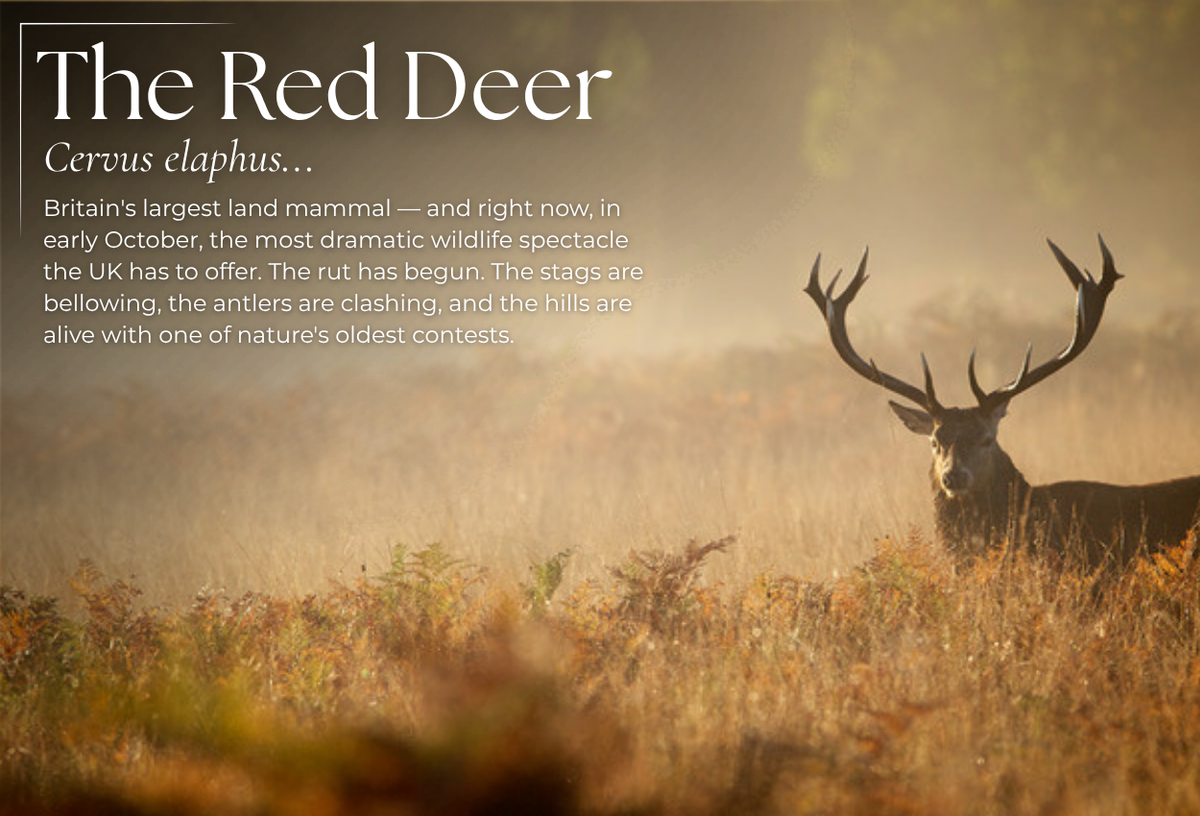
October in the British countryside means one thing: the red deer rut has begun. Britain's largest land mammal transforms completely at this time of year. The stags that spent the summer quietly grazing moorland and woodland edges are now bellowing, clashing and competing in one of the rawest and most dramatic wildlife spectacles these islands have to offer. A dominant stag can hold a harem of up to twenty hinds, but he'll have to fight for every single one of them.
Why October Is the Month to Watch
The rut runs from late September into early November, and it peaks through mid-October. Stags have spent months building condition for this moment, and the activity is concentrated in the first and last hours of daylight, when the air is still and a roar carries for a mile or more.
You don't need to travel to the Scottish Highlands to see it. Some of the best rut watching in the country is in England, in places you can reach for a morning walk. It rewards early starts, patience and a little fieldcraft, and the right binoculars let you watch it all without ever getting too close.
The Red Deer: Britain's Largest Land Mammal
The red deer (Cervus elaphus) is a native species, found on open moorland, in woodland and in managed parkland. Stags can stand well over a metre at the shoulder and carry impressive, branching antlers that are grown and shed every single year.
Red deer are unmistakable once you know the signs. Look for the dark russet-brown coat and pale buff rump patch, together with an elongated, noble face. Stags carry large branching antlers that can span around a metre across and weigh up to 15kg, while hinds are smaller and antler-free. In the rut, stags also grow a thick, dark mane around the neck and often look wet and muddy from wallowing.

Reading the Rut
Knowing what you're watching makes it far more rewarding. A rutting stag goes through a predictable sequence of behaviour:
Roaring: Stags bellow to proclaim territory and advertise their strength. A deep, rolling roar echoing across a misty hillside is one of the most extraordinary sounds in British nature.
Parallel walking: Rival stags often march stiff-necked alongside one another, sizing each other up. Most contests end here, with the weaker stag backing down.
Clashing: When neither backs down, antlers lock and the stags shove head to head. It's loud, powerful and over in moments, which is why a wide, steady view helps you catch it.
Herding: The dominant stag circles his hinds, rounding up stragglers and chasing off challengers, often without pausing to eat.
Where to Watch in the UK
Exmoor, Somerset & Devon
Exmoor is home to one of England's few genuinely wild red deer herds and offers some of the finest rut watching in the south-west. Heather moorland and wooded combes give you both open views and atmospheric dawn mist. Scan the valley sides from a distance at first light.
Richmond Park, London
Remarkably, one of the best-known rut sites is inside Greater London. The park's red and fallow deer are used to people, so views are excellent, but that's also why keeping a respectful distance matters. Go at dawn on a weekday to beat the crowds.
The New Forest, Hampshire
The New Forest is better known for its fallow deer rut, which usually peaks a little later in October, but it also holds a smaller population of red deer. Ancient woodland and open heath give it a classic rut setting. Deer move between cover and clearings, so pick a clearing near the woodland edge and let the action come to you.
The Lake District, Cumbria
Fell-side red deer are among the most dramatic to watch, with roaring stags silhouetted against the hills. Valleys such as Martindale are well known for the rut. Bring warm layers: October mornings here can be bitterly cold.

Choosing the Right Binoculars
The golden rule of rut watching is to keep your distance, and binoculars are what make that possible. Dawn and dusk are the best times to watch, so you want optics that gather plenty of light and stay steady in the hand.
For a great-value start: The FOREFRONT 10x42 in Forest Green brings a stag across a valley close enough to count the tines, and its 42mm lenses handle low morning light well.
For most watchers: The PROTOBIRD 8x42 (also in Woodland Khaki) gives a wide field of view and a steady image, ideal for following a stag as he charges across a clearing. If you prefer more reach, the PROTOBIRD 10x42 is a superb all-rounder.
For the best possible image: The ECHOBIRD 10x42 uses ED glass for sharper, higher-contrast views, which makes a real difference in the grey light of an October dawn when a stag is half hidden in mist.

Tips for a Successful Watch
- Go at dawn. Stags are most vocal and active in the first hours of daylight and again at dusk.
- Keep your distance. Stay at least 50 metres from deer. Rutting stags are unpredictable and can be dangerous, so let your binoculars do the work.
- Stay downwind. Deer have an excellent sense of smell. Walk into the wind and they won't know you're there.
- Listen first. Follow the roaring to find the action, then scan the ground with your binoculars before moving closer.
- Dress for the cold. Early autumn mornings are chilly and you may be standing still for a while.
- Keep dogs on a lead, or leave them at home. They disturb deer and can provoke a stag.
Make the Most of October
The red deer rut is one of the great wildlife events of the British year, and it only lasts a few weeks. Whether you're on a misty Exmoor hillside or in a London park at dawn, the right binoculars turn a distant silhouette into a moment you'll remember.

Leave a comment
This site is protected by hCaptcha and the hCaptcha Privacy Policy and Terms of Service apply.