
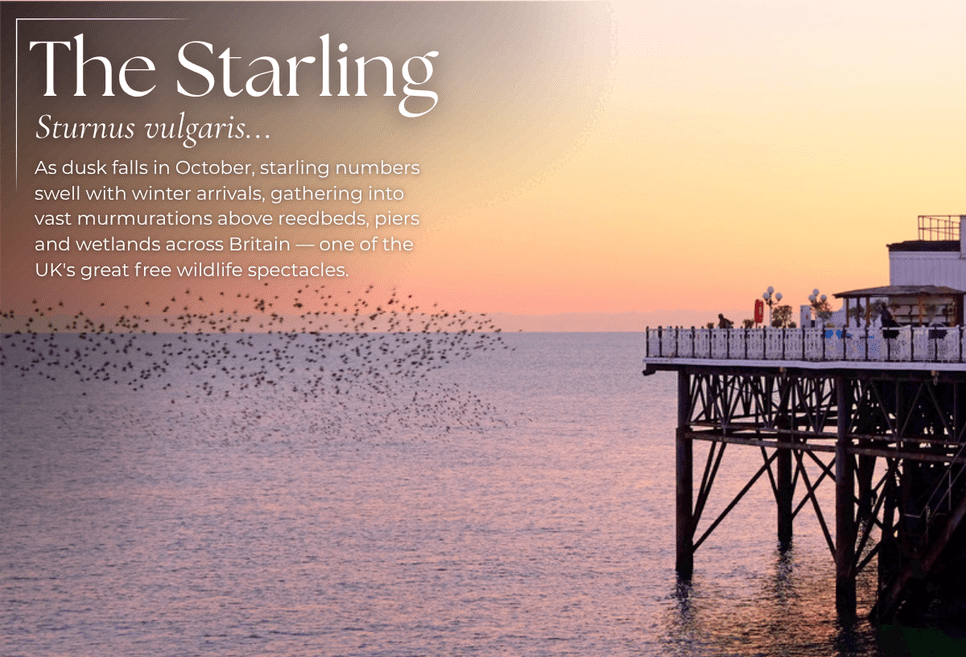
As dusk falls across Britain in October, something extraordinary starts to build over our wetlands, piers and reedbeds. Thousands, sometimes hundreds of thousands, of starlings gather in the fading light and twist together into vast, shape-shifting clouds — a murmuration. It's one of the most spectacular wildlife events in the UK calendar, entirely free, and it's just getting started.
Why October Is the Month to Watch
Murmurations happen year-round in small numbers, but October marks the point where resident starlings are joined by huge numbers of continental birds arriving for winter, swelling roosts dramatically. Numbers build through autumn and typically peak in November and December, but October offers something the depths of winter doesn't: milder evenings, more forgiving light, and roosts still growing in size and spectacle night by night.
What's Actually Happening
The exact reason starlings murmurate is still debated among scientists, but the leading theories point to two things: safety in numbers against predators like peregrines and sparrowhawks, and warmth — huddling together overnight in a shared roost. What's certain is the mechanism: each bird tracks the movement of roughly seven neighbours, creating the fluid, almost liquid patterns that ripple through the flock in fractions of a second.
The display usually builds over 20–40 minutes before sunset, as smaller groups arrive and merge into ever-larger flocks, before the whole roost drops suddenly and dramatically into the reedbed or woodland below.

Where to Watch
Ham Wall, Somerset

The Somerset Levels host one of the largest and most reliable murmurations in the UK, sometimes exceeding a million birds at peak season. RSPB Ham Wall and neighbouring Shapwick Heath both offer excellent, open views.
Brighton's West Pier, East Sussex
An unmissable urban spectacle — the skeletal ironwork of the old West Pier provides a dramatic roost site, with the murmuration visible right from the seafront. No need to travel far if you're local to the coast here.

Aberystwyth, Wales
Another town-centre murmuration, viewable from the promenade as starlings roost under the Victorian pier. Easily one of the most accessible sites in Britain, no reserve entry or hide required.
Gretna Green, Scottish Borders
Home to some of the UK's largest winter roosts, with numbers building into the hundreds of thousands as the season progresses.
Newport Wetlands, Wales
A reliable Severn Estuary site with reedbed roosts and good visitor facilities, particularly strong from mid-autumn onward.
What to Look For
Arrive 30–45 minutes before sunset and watch the sky rather than the ground — the first small groups often appear high and distant before the real display builds. Look for the flock's shape constantly reforming: a ribbon becomes a sphere, stretches into a funnel, folds back on itself. The best displays often happen on calm, cold evenings; wind tends to break up the tightest formations.
Choosing the Right Binoculars
Murmurations are a genuine low-light challenge: you're watching fast, unpredictable movement in the last usable light of the day, which asks a lot of a pair of binoculars.
For most murmuration watching: The PROTOBIRD 8x42 is well suited here — 8x magnification and a wide field of view make it far easier to keep the whole flock in frame as it swells and reshapes.
For the last usable light: The ECHOBIRD 10x42's ED glass and large objective lens pull in noticeably more light as the sky darkens, extending the window before the display becomes too dim to follow clearly.
For a lightweight evening outing: The ECHOBIRD 8x32 keeps things comfortable for a standing, hands-up viewing session without sacrificing brightness.

Tips for a Successful Watch
- Arrive early and stay patient. The best moment is often the final few minutes before the flock drops into roost — don't leave too soon.
- Check recent sightings. Roost sites shift through the season; local wildlife trust and RSPB social accounts often post daily murmuration updates in season.
- Dress for standing still in the cold. October evenings turn cold fast once the sun's down and you're not moving.
- Watch for predators. A sparrowhawk or peregrine attack is often what triggers the tightest, most dramatic formations — keep an eye out overhead.
- Leave the flash photography at home. It doesn't work at this range and distance, and can disturb the roost.
Don't Miss the Show
Murmurations are one of the few genuinely awe-inspiring wildlife spectacles you don't need to travel far or pay a penny to see. Whether it's a few thousand birds over a local reedbed or a million-strong roost on the Somerset Levels, there's nothing quite like watching a flock move as one.

Leave a comment
This site is protected by hCaptcha and the hCaptcha Privacy Policy and Terms of Service apply.