
By September, the great reshuffle is underway. The swifts are long gone, the swallows and house martins are gathering in restless, chattering flocks over reservoirs and rooftops, and along the coast a quieter but equally remarkable spectacle is building: visible migration, or "vis-mig" as birders call it — the sight of birds moving south in real time, often in their thousands, streaming past a single fixed point.
Why September Is the Month to Watch
Autumn migration doesn't happen all at once — it builds through September and peaks into October, but the first weeks of the month bring some of the most reliable and varied passage of the whole season. Hirundines (swallows, house martins and sand martins) are making their final push south, insectivorous songbirds are passing through in numbers, and the first hint of easterly wind can bring a genuine fall of migrants to the east coast overnight.
Unlike summer's territorial, predictable birds, September's migrants are moving — which makes timing and location everything. Get both right, and a single morning at the coast can bring more species past your binoculars than a month of garden watching.
What You're Actually Watching: An Introduction to Vis-Mig
Visible migration is exactly what it sounds like: birds flying past, usually low and directional, usually in the first few hours after dawn. Unlike a static bird sitting in a bush, vis-mig rewards binoculars that focus fast and track smoothly — you often have seconds, not minutes, to get on a bird before it's gone.
House Martins and Swallows
Still present in good numbers through early September, both species gather over open water and reedbeds to feed heavily before departure. Look for the swallow's deep blue back and long tail streamers, against the house martin's stockier build, white rump and shorter, forked tail. Pre-roost gatherings over reservoirs at dusk can number in the hundreds.
Wheatears
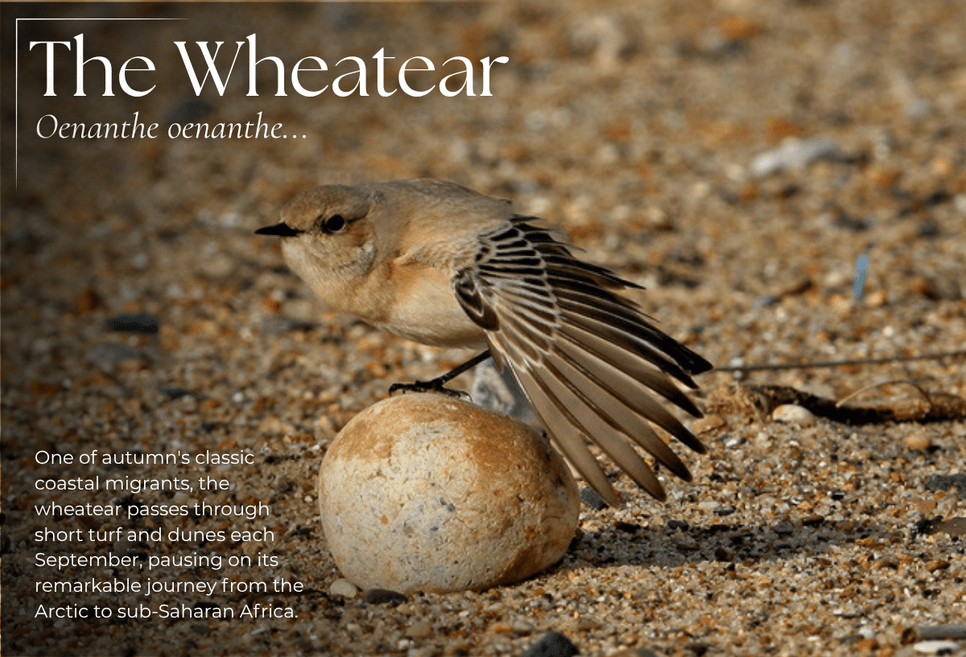
One of the classic September coastal migrants. Wheatears favour short turf, dunes and stony ground, bobbing and flicking their tails as they move. Look for the pale supercilium (eyebrow stripe) and, in flight, the diagnostic white rump and black "T"-shaped tail pattern that gives the species its old name — "white-arse."
Redstarts and Whinchats
Both pass through scrub, hedgerows and bracken edges in September, often associating loosely with other migrants. The male redstart's rust-red tail, constantly quivered, is unmistakable even in poor light. Whinchats show a bold pale supercilium and perch prominently on fence posts and tall grass stems, unlike the more skulking stonechat.
Meadow Pipits
The backbone of any September vis-mig count. Meadow pipits move south in loose, calling flocks — often the first and most numerous birds of a morning's watch, and a useful indicator that visible migration is happening at all.

Where to Watch
Spurn Point, Yorkshire

Britain's most famous vis-mig site. This narrow spit funnels migrants along the coast, and the Bird Observatory's daily counts regularly run into the thousands during good September conditions. An essential site for anyone serious about autumn migration.
Portland Bill, Dorset
A south-coast counterpart to Spurn, Portland's geography concentrates migrants heading out over the Channel. The observatory here has decades of records and is superb for both vis-mig and grounded migrants in the surrounding quarries and gardens.
Dungeness, Kent
Flat, open and exposed, Dungeness draws migrants funnelling along the Kent coast. The RSPB reserve and surrounding shingle make for varied watching, from passing raptors to grounded warblers in the scrub.
Gibraltar Point, Lincolnshire
A reliable East Anglian site for both vis-mig and coastal passage, with dunes, saltmarsh and scrub habitats that hold migrants down after an overnight fall.
Hilbre Island, Wirral
A tidal island in the Dee Estuary, Hilbre offers a west-coast perspective on autumn passage, with wader and seabird movement alongside the songbird migration typical of east-coast sites.
What to Look For
Vis-mig rewards a particular kind of watching: scan the horizon and let birds come to you rather than hunting through cover. Most passage happens in the first two to three hours after dawn, with birds flying low and purposefully, often calling as they go — learning a handful of key flight calls (meadow pipit, redstart, tree pipit) will help you log far more than sight alone.
Wheatear in flight: white rump, black tail band, direct low flight over open ground.
Hirundines: loose, drifting flocks feeding on the wing rather than the purposeful, directional flight of true migrants overhead.
Redstart: quivering rust-red tail, usually seen perched rather than in flight.
Choosing the Right Binoculars
September migrants are often small, fast-moving and backlit against a bright morning sky — a demanding combination that rewards binoculars built for speed and clarity.
For most vis-mig watchers: The PROTOBIRD 8x42 is an excellent all-rounder — the wider field of view at 8x makes it far easier to pick up fast-moving birds and stay with them, which matters more at a vis-mig watchpoint than raw magnification.
For scanning distant flocks and offshore passage: The PROTOBIRD 10x42 brings extra reach, useful for picking out raptors and larger flocks moving well offshore.
For serious migration watchers: The ECHOBIRD 10x42's ED glass earns its keep against the low, bright autumn sun — chromatic aberration is exactly the kind of colour-fringing that makes backlit birds hard to identify, and ED glass largely eliminates it.
For an all-day, lightweight option: The ECHOBIRD 8x32 is compact enough for a long dawn session without fatigue, without giving up ED-glass clarity.

Tips for a Successful Watch
- Get there for first light. The bulk of visible migration happens in the first two to three hours after dawn — arrive late and you'll miss the main passage.
- Check the wind. Light easterly or northeasterly winds after a clear night often produce the best "falls" of migrants on the east coast.
- Learn a few flight calls. Many vis-mig birds are logged by ear as much as by eye — meadow pipit's thin "sip-sip" is a good place to start.
- Dress for standing still. Coastal watchpoints are exposed, and a couple of hours scanning the horizon gets cold fast, even in September.
- Keep a count. Vis-mig is as much about numbers as species — a simple tally of what's moving builds a picture of the morning that a single sighting can't.
Make the Most of September
Autumn migration is one of the UK's great, under-watched wildlife spectacles — no ticket, no booking, just a coastline, a clear dawn, and the right pair of binoculars. Whether you're picking out your first wheatear on a dune or logging hundreds of meadow pipits streaming south, September rewards those who show up early and watch closely.

Leave a comment
This site is protected by hCaptcha and the hCaptcha Privacy Policy and Terms of Service apply.