
Two of Britain's most exhilarating birds are at their peak in August — and both are gone before the leaves turn. The hobby, a small falcon of extraordinary speed and agility, spends its summer hunting dragonflies and hirundines over heathland and wetland. The swift, one of the most aerial creatures on earth, screams through village skies in its final weeks before a non-stop journey back to sub-Saharan Africa. August is your last reliable window to watch both — and it's worth making the most of it.
Why August Is the Month to Watch
By August, hobby chicks are fledging and adults are hunting at maximum intensity to fuel the coming migration. Swifts, meanwhile, begin departing from late July, with most gone from UK skies by mid-August. The overlap — hobby hunting the last swifts and swallows, swifts screaming in tight flocks before departure — creates some of the most dramatic aerial wildlife spectacles the UK has to offer.
Both species reward patience and good optics. They move fast, change direction instantly, and rarely give you long at any one angle. The right binoculars make the difference between a blur and a genuine sighting.
The Hobby: Britain's Most Agile Falcon
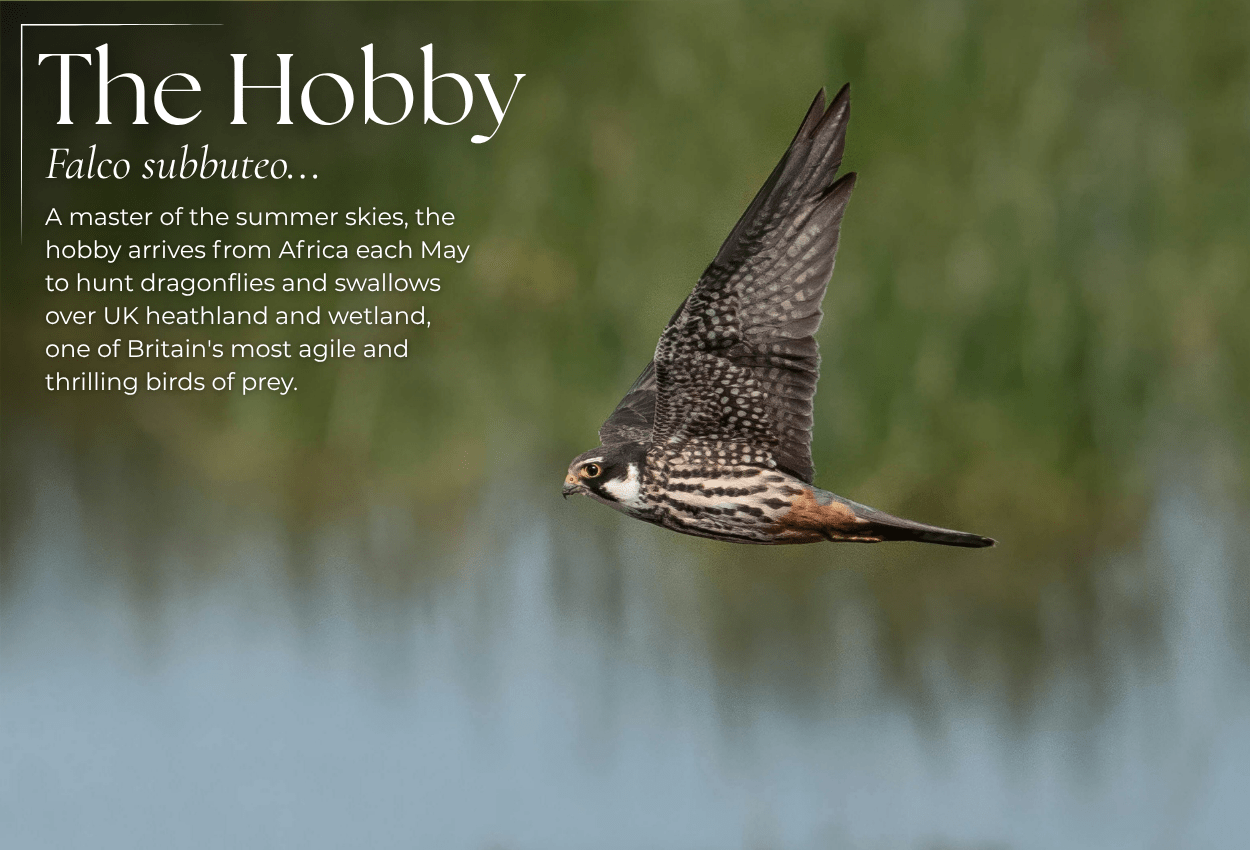
The hobby (Falco subbuteo) is a summer visitor, arriving from Africa in May and departing again by October. Roughly the size of a kestrel but far more dynamic in flight, it's capable of catching swifts and swallows on the wing — a feat that requires extraordinary speed and precision.
In flight, look for the long, scythe-like wings and relatively short tail — a silhouette somewhere between a swift and a peregrine. Adults show a distinctive rufous (brick-red) vent and heavily streaked underparts, with a bold black moustache stripe against a white cheek. Juveniles lack the rufous vent but share the same athletic flight profile.
Hobbies hunt low over water and reed beds in the morning, switching to higher aerial pursuits — dragonflies, swifts, martins — as thermals develop through the day. Watch for the characteristic stoop and snatch: a sudden acceleration, a brief aerial struggle, and then the bird eating on the wing as it continues to fly.
The Swift: The Sky's Most Committed Traveller
The common swift (Apus apus) is one of the most remarkable birds in the world. It eats, sleeps, and mates on the wing, only landing to nest. By August, the season is almost over — adults have already begun departing, and the screaming parties that filled summer evenings are thinning fast.
Swifts are unmistakable: all-dark, with a forked tail and long, swept-back wings forming a distinctive anchor shape. They fly faster than swallows and martins, and their screaming call — a high, piercing shriek — is one of the defining sounds of a British summer.
In August, watch for swifts gathering in large flocks before departure, often circling high in the evening. These pre-migration gatherings can number in the hundreds and are a spectacular sight through binoculars.

Where to Watch in the UK
Thursley Common, Surrey
One of the best hobby sites in southern England. This lowland heath and bog holds breeding hobbies and is exceptional for dragonflies — the hobby's primary prey in late summer. The open terrain makes aerial hunting easy to follow.
Wicken Fen, Cambridgeshire
The National Trust's oldest nature reserve. Hobbies hunt over the fen throughout summer, and the open skies make tracking fast-moving birds straightforward. Swifts are also present in good numbers through August.
Minsmere RSPB, Suffolk
A reliable hobby site with open reed beds and scrape habitats that attract the dragonflies and hirundines hobbies depend on. The reserve's hides give elevated views across open water — ideal for watching aerial hunting behaviour.
Oxford Swift City Project, Oxfordshire
Oxford has one of the UK's best-documented urban swift populations. The city centre rooftops and spires host nesting swifts through July, with departures visible from late July into August. A good urban option if you're not near heathland.
Dartmoor, Devon
Open moorland with good hobby populations. The combination of upland heath, valley wetlands, and large insect populations makes this a productive area for late-summer watching.

What to Look For
Both species demand quick reactions and binoculars that can track fast, unpredictable movement. Key identification points:
Hobby in flight: Scythe-shaped wings, streaked underparts, rufous vent on adults. Watch for the characteristic stoop — a sudden acceleration into a dive — followed by an aerial catch. The bird will often eat on the wing immediately after.
Swift in flight: All-dark, anchor-shaped silhouette, screaming call. Swifts fly faster and higher than swallows and house martins. In August, look for large pre-migration flocks circling high in the evening sky.
Telling them apart from similar species: Hobby vs kestrel — hobby has pointed wingtips and rarely hovers; kestrel hovers frequently. Swift vs swallow — swift is all-dark with no white underparts; swallow has a red throat and white belly.
Choosing the Right Binoculars
Fast aerial birds are one of the most demanding subjects in birdwatching. You need binoculars that focus quickly, track smoothly, and deliver a wide enough field of view to relocate a bird that's just changed direction at speed.
For most watchers: The PROTOBIRD 10x42 is the natural choice for hobby watching — the 10x magnification brings distant birds in close, and the 42mm objective lens handles the variable light conditions you'll encounter over open water and heath. Available in Urban Grey and Woodland Khaki.
For tracking fast-moving swifts: The PROTOBIRD 8x42 (available in Urban Grey and Woodland Khaki) offers a wider field of view and steadier image at 8x — useful when you're trying to keep a screaming swift in frame as it changes direction.
For serious birders wanting the best: The ECHOBIRD 10x42 uses ED glass to eliminate chromatic aberration — the colour fringing that can affect image quality when tracking a dark bird against a bright sky. The optical step up is immediately noticeable when trying to resolve the rufous vent on a distant hobby.
For a lightweight option: The ECHOBIRD 8x32 is compact enough to carry all day without fatigue — a good choice if you're combining swift watching with a longer walk or mixed wildlife day.

Tips for a Successful Watch
- Go early and late. Hobbies are most active in the morning when hunting low over water, and again in the evening when dragonfly activity peaks. Swifts gather in the evening before roosting on the wing.
- Find the prey first. Hobbies follow their food — locate a good dragonfly pool or a hirundine roost and the hobby will come to you. Swifts concentrate where flying insects are abundant.
- Use a wide field of view. Fast aerial birds disappear from view instantly. A wider field of view (typically 8x binoculars) makes it easier to relocate a bird after it changes direction.
- Be patient at known sites. Hobbies are territorial and return to the same hunting areas repeatedly. If you find a productive spot, stay with it.
- Act now. Swifts are largely gone by mid-August. Hobbies follow in September. The window is short.
Make the Most of August
The hobby and the swift are two of Britain's most thrilling wildlife spectacles — and August is the last reliable month to see both. Whether you're watching a hobby stoop on a dragonfly over a Surrey heath or tracking a screaming swift flock against an evening sky, the right binoculars turn a fleeting glimpse into a moment you'll remember.

Leave a comment
This site is protected by hCaptcha and the hCaptcha Privacy Policy and Terms of Service apply.